Aktiv360 | Quality, Compliance, Process Consultancy | Corporate Solutions Focused on GMP, Regulations, Validation, and Audits
×
All rights reserved. All content and visuals used on this website
are the property of Aktiv360 Consulting, and any unauthorized use is subject to legal action.
İnviva
 Aktiv360 | Quality, Compliance, Process Consultancy | Corporate Solutions Focused on GMP, Regulations, Validation, and Audits

Aktiv360 Compliance & Consulting
Your Solution Partner in Quality and Processes
360° Compliance, Sustainable Strength

INSTALLATION OF QUALITY MANAGEMENT SYSTEMS

1.1 -) GMP Compliant Quality Management Systems Installation

What Is It ?

GMP (Good Manufacturing Practices) is the fundamental production standard mandated by the Turkish Medicines and Medical Devices Agency (TİTCK) in Turkey, which ensures that pharmaceuticals, dietary supplements, and traditional herbal products are produced in a reliable, consistent, and compliant manner with regulatory requirements.

GMP is also a global production safety framework accepted by international authorities such as EU GMP, FDA cGMP, and WHO GMP, and is therefore a critical requirement for export, contract manufacturing, and global partnerships.

Why Is It Necessary ?

- It is essential to establish a controlled and sustainable quality system that will guarantee product safety.
- GMP compliance is the direct legal responsibility not only of operational teams, but also of senior management.
- All production processes must be defined, validated, controlled, and traceable; otherwise, serious quality and safety risks arise.
- GMP deficiencies can lead to strong consequences such as loss of customers, export barriers, production stoppage, regulation suspension, audit failure and damage to brand reputation.
In short: When compliance with Good Manufacturing Practices (GMP) is not ensured, product safety, corporate reputation, export opportunities, and audit processes are directly at risk.

How We Do It ?

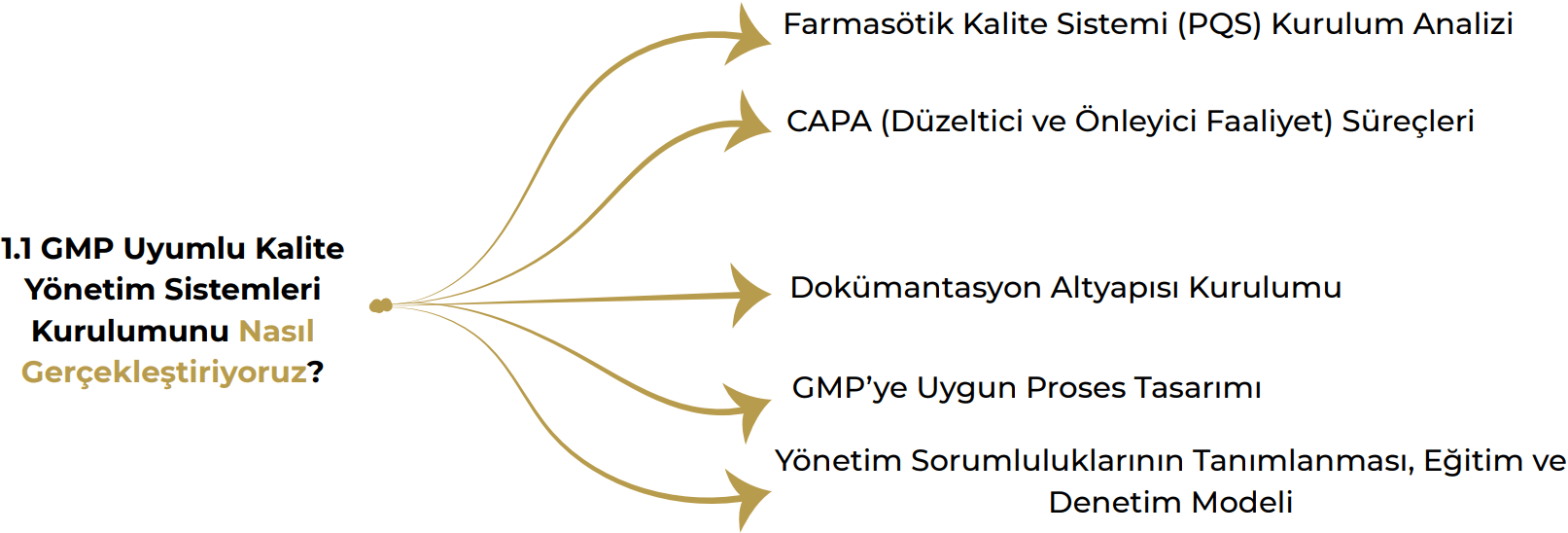
Pharmaceutical Quality System (PQS) Installation Analysis
We determine the maturity level by assessing the compliance of your current system with GMP requirements. In this project, we address the following areas specific to your organization:
- organizational structure,
- distribution of duties and responsibilities,
- risk management,
- risk management,

CAPA (Corrective and Preventive Action) process,
- supplier management,
- training and competency system

Documentation Infrastructure Installation
- Creation of SOP (Standart Operating Procedure), instructions, forms and record systems
- Establishing document approval, revision, and archiving structures
- Providing a traceable documentation infrastructure that is always ready for audit.

GMP Complient Process Design
- Restructuring of the production flow
- Securing critical process steps
- Validation-compliant, lean, and sustainable process design

Definition of Management Responsibilities, Training and Audit Model
- Strengthening the management commitment
- Training (Educational) matrix and competency assessment system
- Internal and external audit model, annual audit plan, and findings management structure

Is It Necessary For You ?

If even one of the following questions is "Yes," this service is critical for your business:
1 - Are you about to undergo an authority audit, customer audit, or international compliance audit?
2 - Is documentation, record keeping, and process management not working properly or being tracked?
3 - Are your production processes not defined, validated, and traceable?
4 - Have customer complaints, product nonconformities, recall risks, out-of-specification results or deviations increased recently?
5 - Do you have any regulatory requirements in your export, contract manufacturing, or new product launch processes?

If you answer "yes" to even one of these → This service is critical to the security, reputation, and sustainability of your business.

1.2 -) ISO 9001 Integration & Continuous Improvement

What Is It ?

The ISO 9001 Quality Management System is an international standard that enables organizations to standardize their processes, increase operational efficiency, and manage quality in a sustainable manner.

Integrating ISO 9001 with GMP (Good Manufacturing Practices) in the pharmaceutical, dietary supplement, and traditional herbal product sectors both strengthens corporate quality culture and ensures more effective implementation of GMP in the field.

This integration ensures that the quality system is fueled not only by technical requirements, but also by corporate governance, process efficiency, and a culture of continuous improvement.

Why Is It Necessary ?

- ISO 9001 requires a structure where processes are clearly defined, performance indicators are monitored, measured, and continuously improved.
- A corporate framework is necessary for GMP compliance to be sustainable, and ISO 9001 provides this framework.
- Uncertainties in management systems or disconnects between departments directly impact quality; ISO 9001 integration reduces these risks.
- It strengthens operational continuity by ensuring that processes are system-based rather than person-dependent.
- ISO 9001 is an important sign of trust in international collaborations, projects involving suppliers, and customer audits.
In short: The ISO 9001 Quality Management System matures the organization's quality management system, strengthens GMP practices, and increases operational efficiency.

How We Do It ?

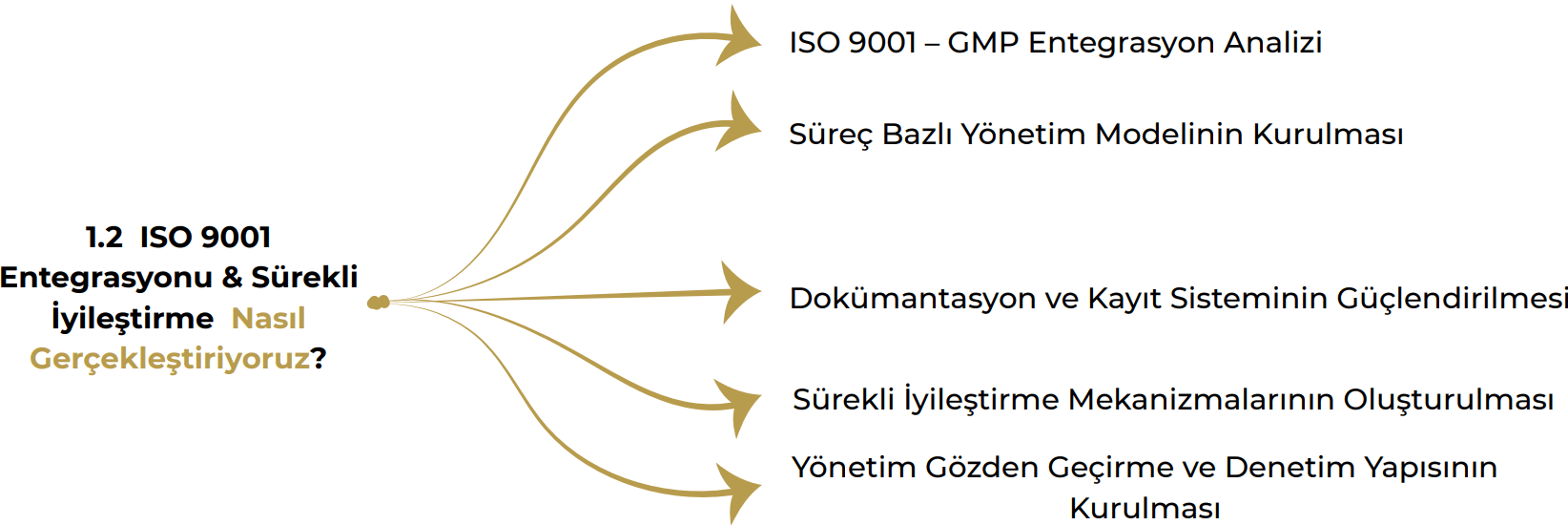
ISO 9001 – GMP Integration Project
We review your current quality system according to both ISO 9001 and GMP requirements and determine the level of integration. This project covers the following areas specific to your organization:
- process management and flow charts,
- key performance indicators (KPI),
- management review structure,
- risk-based thinking model,
- internal audit approach,
- documentation structure and job definitions.

Establishment of a Process-Based Management Model
- Defining and mapping all processes
- Appointment of process owners
- Determination of measurable performance criteria
- Strengthening integration between departments

Strengthening the Documentation and Record System
- Standard Operating Procedure (SOP), instruction, form, and record structure compliance with ISO + GMP
- Systematic management of the document lifecycle (creation, review, approval, revision)
- Establishing a trackable, audit-ready document infrastructure

Establishing Continuous Improvement Mechanisms
- Strengthening the Corrective and Preventive Action (CAPA) management system
- Performance analysis & data-based improvement cycles
- Process maturity assessments
- Design of inter-departmental improvement projects

Establishment of Management Review and Audit Structure
- Systematization of management review meetings
- Creation of internal and external audit plans
- Analysis of findings and planning of sustainable solution

Is It Necessary For You ?

If even one of the following questions is "Yes", ISO 9001 integration may be a critical need for your business:
1 - Is the internal and external audit system not working or does it not exist at all?
2 - Is the management review mechanism not being followed or ineffective?
3 - Are you experiencing recurring situations in CAPA (Corrective and Preventive Action) processes?
4 - Are key performance indicators (KPIs) undefined or not being measured?
5 - Do you think processes are dependent on individuals and want a more institutional structure?

If even one is "yes" → ISO 9001 integration is a critical step for your business's sustainability.

1.3 -) Technical Document & Regulatory Compliance Management (Dietary Supplements & Herbal Products)

What Is It ?

In order for dietary supplements and traditional/herbal products to be marketed, the products must fully comply with both Turkish regulation (TİTCK, Ministry of Agriculture and Forestry) and the foreign market authorities of the target countries.

In this context, the product's :
- formulation,
label-decleration information,
- ingredient verification,
- quality and safety data,
- technical document structure,
- drug/extract characterization,
- pharmacopeia and monograp requirements
must be submitted in the correct format.

The scope prepared includes ;
- TITCK notification technical documents
- Herbal products quality documents
- monograph compliance sets
- dietary supplements export documents
- country-based technical requirement packages
and all other regulatory compliance files.
The purpose of this project is to ensure the fast, secure, and seamless entry of your product into local and international markets.

Why Is It Necessary ?
- Incomplete or incorrect technical documentation delays or prevents the product's entry into the market.
- Label-declaration-content inconsistencies result in the product being removed from shelves, deficiency notices, sales suspension, fines, or recalls.
- Applications will be rejected or delayed if monographs, standardization, and pharmacopoeia compliance are not ensured for herbal products.
- Each country has different export/import requirements; if these rules are not followed, the product will not be accepted in the market.
- A well-organized, complete, and up-to-date technical document enhances the company's reliability in both local inspections and export processes.
In short: Technical documentation and regulatory compliance are the most critical steps in determining the commercialization of your product.

How We Do It ?

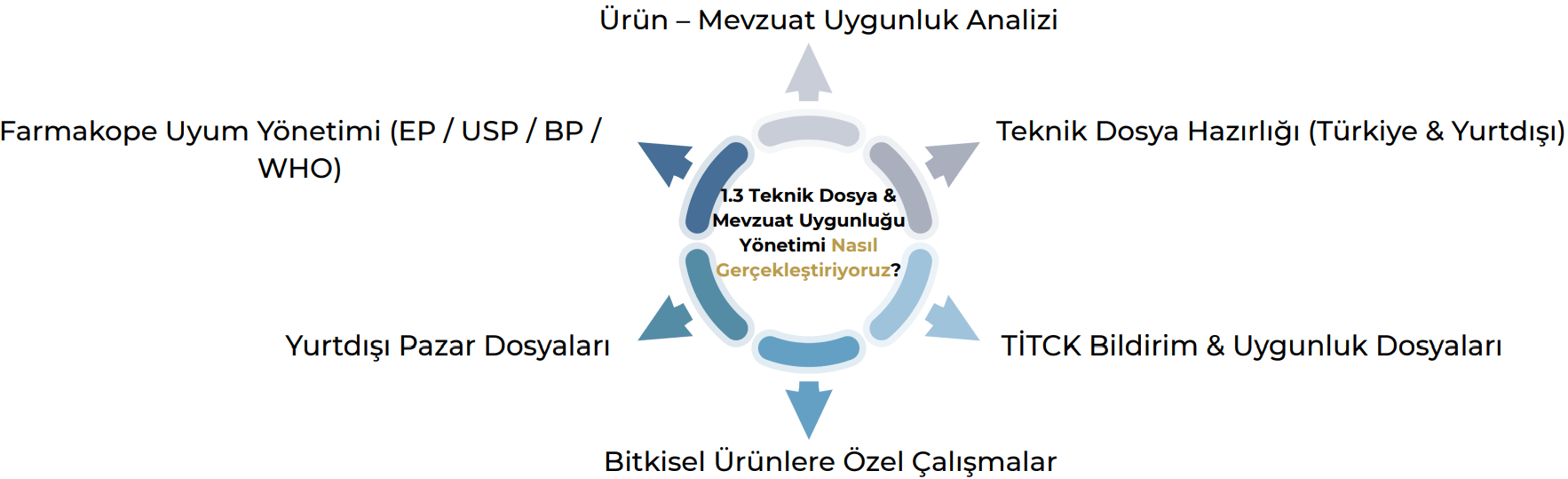
1) Product - Regulatory Compliance Determination
- Component & dosage suitability
- Prohibited/restricted substance control
- Label-declaration-content consistency
- Monograph and standardization compliance in herbal ingredients
- Compliance of the formula and process with regulations

2) Technical Document Preparation (Türkey & Abroad)
- Product information documents
- Production flow and process descriptions
- Drug/extract descriptions
- Specifications & analysis reports
- Stability - shelf life datas
- Literature/clinical support files, if necessary

3) TITCK Notification & Compliance Documents
- Component compatibility detection
- Technical document preperations
- Label & decleration control
- Closing deficiency notices
- End-to-end management of the application

4) Special Studies on Herbal Products
- Drug/extract characterization
- Marker compound analysis strategy
- Standardization model
- Safety profile & literature review

5) Foreign Market Documents
- Country-based technical requirements analysis
- Label-decleration adaptation
- Technical file formatting
- Mandatory document sets for contract manufacturing/export

6) Pharmacopeia Compliance Management (EP / USP / BP / WHO)
Pharmacopeia compliance is the technical basis of regulatory compliance:
- EP/USP/BP/WHO monograph compliance
- Specification set creation
- Identity, purity, limit, marker tests
- Analysis method validation strategy
- Third-party laboratory test plan
- Pharmacopeia-compliant quality documentation for export
In this way, the quality structure of your product is guaranteed according to international standards.

Is It Necessary For You ?

If even one of the following questions is "Yes", this service is critical for you:
1 - Not sure if you have a label-declaration-content structure that is fully compliant with regulations?
2 - Is your technical file or TITCK notification process getting longer due to missing articles?
3 - Are you experiencing uncertainty regarding monographs, standardization, or pharmacopeia compliance for herbal products?
4 - Are you struggling to meet country-specific technical requirements when entering new markets?
5 - Do you want to guarantee that the technical file is prepared correctly for the new product, new contract manufacturer or export process?

If there is even one "yes" → Technical document & regulatory compliance management is critical for your product to reach the market safely, quickly, and sustainably.

1.4 -) Corporate Quality Culture & Sustainable Process Design ?

What Is It ?

Corporate quality culture is a management model that enables a business to embrace quality not merely as a "departmental task," but as a company-wide shared approach.Sustainable process design ensures that all operations become:
- defined,
- repeatable,
- measurable,
- audit-ready,
- independent of individuals.
It enables them to achieve a structured framework.

This service transforms all qualitative components of your organization, from its structure to its daily workflows, into an operational model that is agile, sustainable, and compliant with international standards.

Why Is It Necessary ?

- If the quality system is divided into units or is viewed solely as “document management,” sustainability weakens.
- If processes are dependent on individuals, employee changes create critical risks.
- If training, communication, and decision-making mechanisms are unclear, audits are compromised.
- If there is a mismatch between production, quality, R&D, and the supply chain, reliability and efficiency decline.
- A robust quality culture provides a competitive advantage during new product development, export, and technical growth phases.
In short: Businesses without a strong quality culture face risks of operational chaos, quality issues, and recurring audit findings when they want to grow up.

How We Do It ?

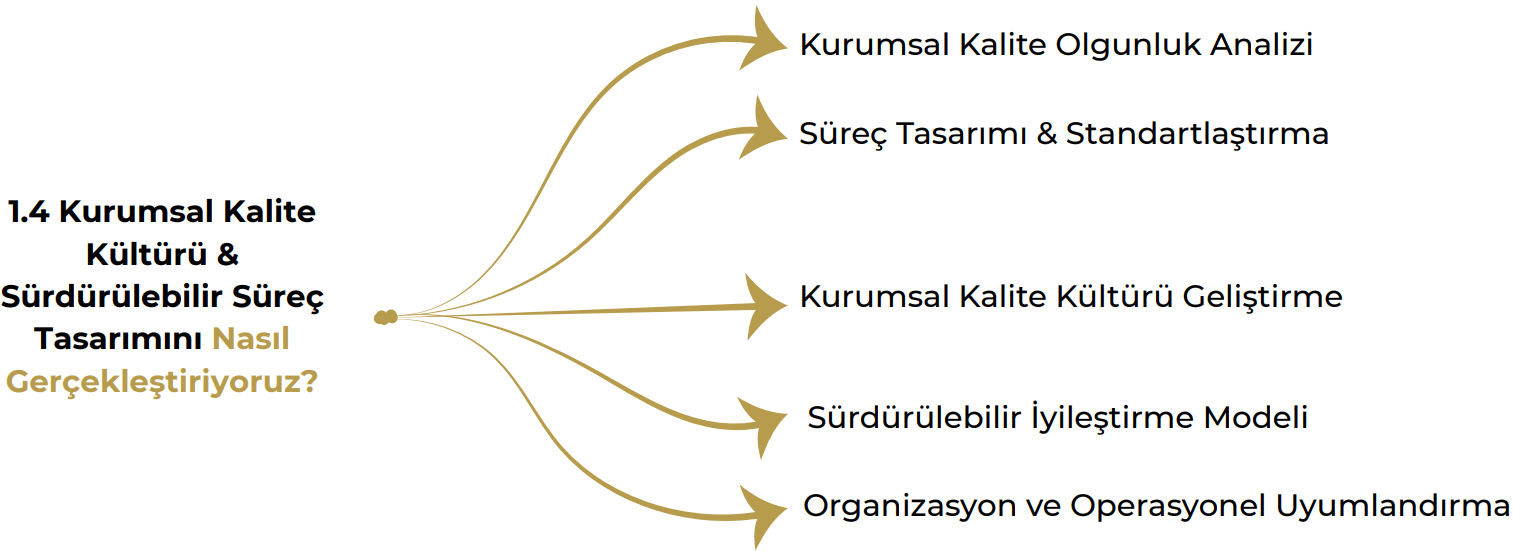
Corporate Quality Maturity Assessment
In the first stage, we evaluate the existing structure. In this project, the following areas specific to your organization are examined:
- Organizational structure,
- Job description,
- Process ownership,
- Decision-making mechanisms,
- Communication and reporting model,
- Training & competency structure,
- Process consistency,
- Risk management approach

Process Design & Standardization
- Defining all processes from start to finish
- Creating responsibility & authority maps
- Simplification of process flows
- Systematization of person-dependent tasks
- Determination of key performance indicators (KPI)
This ensures that the institution is always ready for audit and has a systematic structure.

Developing Corporate Quality Culture
- Structuring the senior management's quality commitment
- Internal communication model: quality announcements, reporting, meeting schedule
- Training matrix and competency management
- Special content for quality awareness & cultural development

Sustainable Improvement Model
- Institutionalization of the Corrective and Preventive Action (CAPA) system
- Standardization of the root cause analysis approach
- Data-based improvement cycles
- Process maturity assessments
- Cross-departmental improvement projects

Organizational and Operational Alignment
- Integrating quality, production, planning, supply chain, and R&D processes into a common quality culture
- Spread of quality culture in contract manufacturing & export operation

Is It Necessary For You ?

If even one of the following questions is "Yes", corporate quality culture and sustainable process design are critical for you:
1 - Are your processes dependent on individuals and experiencing disruptions when employees change?
2 - Are there any process inconsistencies, communication or coordination issues between departments?
3 - Is the distribution of competencies and responsibilities unclear?
4 - Do you have findings or are you at risk of findings due to inconsistencies, missing records, or process confusion during audits?
5 - Do you want to strengthen quality awareness and standardize operations throughout the organization?

If there is even one "yes" → Quality culture & process design support is critical for your business's sustainable growth and an audit-ready operational model.